Alasdair McIntyre, Walter Farrel OP, and Charles de Koninck, among others, agree that Suárez (1548-1617) was neither a Thomist nor a reliable interpreter of Thomism...Unfortunately, this is quite an inaccurate reading of Suárez as an “American style” social contract proponent. Specifically, according to Professor Kincaid, “Suárez supports the claim that the community has an intrinsic power to make law ….” Yet, saying this is beyond pushing the envelope.[6] Whereas for Aquinas the polis grew somewhat spontaneously as individuals teamed into families, groups of laborers, and towns, Suárez posited that the polis was created through an actual, affirmative delegation of power from the people to the prince.
https://thenewdigest.substack.com/p/the-uses-of-suarez
The Uses of Suarez
A Review of Kincaid, “Law From Below: How The Thought of Francisco Suárez, SJ, Can Renew Contemporary Legal Engagement”
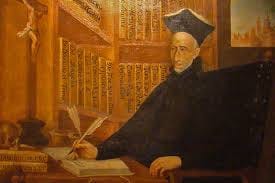
The New Digest is delighted to present this guest essay by Mr. Aníbal Sabater, a partner at Chaffetz Lindsey LLP, a specialist in international arbitration, and a noted commentator on classical legal themes. His previous work in our pages on constitutionalism in Spain and can be found here and here; and his posts at the Ius et Iustitium site, including a series on lawyers and law in Dante, can be found here.
In his 1879 Encyclical Aeterni Patris, Leo XIII urged scholars to read Aquinas directly:
“… lest the false for the true or the corrupt for the pure be drunk in, be ye watchful that the doctrine of Thomas be drawn from his own fountains, or at least from those rivulets which, derived from the very fount, have thus far flowed, according to the established agreement of learned men, pure and clear; be careful to guard the minds of youth from those which are said to flow thence, but in reality are gathered from strange and unwholesome streams.”[1]
While Leo XIII did not identify those “strange and unwholesome streams” that corrupt Thomism, a sizable list of scholars reads the charge as addressed against Francisco Suárez SJ.[2] They may well be right, because the points on which Suárez strays from Aquinas are too many and significant to ignore. To name a few:
(i) On metaphysics, Suárez blurred the distinction between essence and existence in created beings, which would eventually turn him into a favorite of contemporary ontology theorists like Martin Heidegger;
(ii) On free will and pre-destination (the notorious controversy “de auxiliis”), Suárez advanced “congruism,” a position that would eventually be adopted by the Society of Jesus, but is (rightly) viewed in the Order of Preachers as calling into question God’s omnipotence and spousing both Pelagianism and a distorted notion of human freedom, eerily similar to that of political liberalism; and
(iii) On legal theory, Suárez seemed to argue that law resides in God’s will rather than reason, thus opening the door to voluntarism and perhaps totalitarianism.
But if Suárez’s thought runs so significantly athwart the Aristotelian-Thomistic tradition, why do his works remain a reference in the classical legal tradition?[3] Probably because he mounted the last serious criticism of the modern state based on scholastic principles. He recognized the strict separation between the orders of nature and grace, the subordination of the political to the spiritual, and the inability of political power to procure man’s ultimate happiness. The Defensio Fidei, which he published in 1613, developed those topics on the way to analyzing whether English Catholics could take the oath that King James I required from them—and oath essentially disclaiming the Pope’s authority to depose or request the deposal of the excommunicated King.[4]
Ultimately, the Defensio enjoined Catholics not to take the oath, as they remained bound by the laws of the Church and the Pope’s authority over the secular power. In extreme cases, when the secular power ignored natural law and no alternatives availed, the Defensio asserted that tyrannicide may be appropriate.
Although warmly received across most of Christianity, the Defensio became immediately controversial and was rejected not only in England, but also in France, where Gallicanism was evolving into absolutism and curtailments of royal power were no longer countenanced.
Subject to occasional ebbs and flows, interest in Suárez’s Defensio and political thought generally has never abated and actually experienced a revival since Vatican II. Perhaps unsurprisingly, it has been Suárez’s lot that his theological views on papal authority and the subordination of the city of man to the City of God are of less interest now than his calls to resist tyranny. That is certainly the case of a recent book, Professor Elizabeth Rain Kincaid’s Law From Below—How The Thought of Francisco Suárez, SJ, Can Renew Contemporary Legal Engagement, Georgetown University Press (2024).
Professor Kincaid’s starting point is the “current political atmosphere,” in which she claims the executive power tends to impose law “from above,” with limited engagement from, or discussion with the community. Her book is a manifesto for communities to “rediscover” Suárez and participate in the making of law, mostly through the “discernment” of natural law with the sovereign, the development of customs, and the active partaking in legal interpretation, resorting to passive resistance when necessary. Some quotes:
“[I]t is even more important for Christians to recover as many strategies as possible that permit constructive engagement with the law and provide ways to challenge politically imposed injustice and work to oppose autocratic and authoritarian government.” (p. 21).
“Discernment of Natural Law … [A] lawmaker also depends on the people to determine the natural law and to ensure that [positive] laws do not contradict it.” (p. 66.)
Liberation theology theorist Gustavo Ramírez “describes the role of the Church as ‘addressing the oppressed’ to describe for them the agency and power they already possess for standing against the oppressor and addressing the oppressor through ‘prophetic denunciation of these grave injustices.’ Suárez’s theory of law as custom runs in the same intellectual and theological stream as these claims. Given the genealogical connection between Suárez and liberation theology, this similarity is not surprising … Suárez … believes custom has the potential to be a powerful communal engagement tool for challenging and even reforming unjust laws ….” (pp. 110-111.)
“Suárez articulates [legal custom] … as a tool of communal engagement and resistance ….” (p. 137.)
“[Suárez’s] analysis demonstrates his conviction that resistance to unjust laws does not require a rejection of the rule of law but does show how promoting the individual good and the common good are intrinsically connected rather than competitive ends.” (p. 174.)[5]
Perhaps most notably, the gist of the book is that: “The political theology of Francisco Suárez challenges absolutism in its recognition that law is not only a coercive measure imposed from above but also is a communal rule and standard that exists in a constant state of development and constructive dialogue between ruler and citizen.” (p. 48). [Emphasis added.]
Unfortunately, this is quite an inaccurate reading of Suárez as an “American style” social contract proponent. Specifically, according to Professor Kincaid, “Suárez supports the claim that the community has an intrinsic power to make law ….” Yet, saying this is beyond pushing the envelope.[6] Whereas for Aquinas the polis grew somewhat spontaneously as individuals teamed into families, groups of laborers, and towns, Suárez posited that the polis was created through an actual, affirmative delegation of power from the people to the prince. But once this delegation took place, the prince ruled on his own—i.e., was absolute within his own sphere of power—and did not engage with the community except as called for by the laws of the realm.[7] Of course, customs and traditions could be normative, but only because and insofar as the prince agreed to be bound by them, not because any notion of popular sovereignty gave them legal currency. Suárez was quite explicit about this:
“We must devote this Chapter to inquiries respecting the principal efficient cause of consuetudinary law. In this, the consent of the prince must first of all be recognized as necessary for the introduction of a custom. This assertion I have derived from the common teaching of the Doctors.”[8]
In Suárez’s own Spain, on acceding to the throne, each new King was expected to swear to uphold certain fueros or traditions of the realm; but depending on the circumstances the King may decide not to do so or to limit the fueros that would apply. This is consistent with Suárez’s view that the community and the prince did not share in the legislative process, but rather the community was subordinated to the prince by a bond of strict obedience.
Exceptionally, as in the case of King James I’s oath, there may be occasions on which the community must disobey a mandate from the prince; but this is not because the community wields a counter-legislative power, but rather because the prince’s mandate is unjust to start with and as such not genuine law:
“… things which lack reason are not, strictly speaking, susceptible to law, just as they are not capable of obedience …”[9]
“In the mere condition [for its existence] that law should be just, there are included the conditions that law should be [such that obedience] is possible and that it should be useful.”[10]
Professor Thomas Pink has explained at length why, for Suárez, individuals and the community as such are not law makers:
“Suárez writes of individuals as possessing an original and natural liberty. But the distance between his thought and any subsequent contractarianism, let alone any form of liberalism, is considerable. The consent of the community may be a condition of political subordination. But this consent is, as we have noted, an alienation and, except under limited conditions, cannot be retracted. It involves no transfer of rights or power from individuals to their rulers, but only from the community as a whole. Moreover, the community’s consent comes to no more than a shared custom of obedience under conditions that leave this custom to further the common good. And even this shared custom is not, as it would be for Hume, the ultimate source of political authority, but merely a condition under which God, the true ultimate source, grants that authority. It should also be noted that the metaphysical freedom of the individual’s will guarantees no special freedom in questions of religion.”[11]
Far-fetched as it maybe, the attempt to turn Suárez into a champion of some sort of dialectical exchange between the prince and the community to jointly make better laws, is a representative sign of these times, when the classics are often ignored or titivated to modern taste, but rarely engaged with directly. If this reviewer can indulge on a personal musing, reading Law from Below brought to mind the 2013 film The Great Beauty / La Grande Bellezza,[12] in which a party of friends ambulates and carouses in the impressive urban landscapes of 21st century Rome seeking meaning to life, without realizing that what gives meaning to life is already acknowledged in the ancient monuments that provide the background to their bacchanalia.
Like those monuments, Suárez, his shortcomings notwithstanding, is still there. Rather than re-inventing him, why not read him in his own terms? He had definite, and actually quite reasonable, views on what makes a government and an act of government illegitimate. Why not apply those views to current events and discuss the obligations of the faithful when faced with illegitimacy? What perspective can Suárez bring to the application of contemporary documents such as Dignitatis Humanae that discuss the coercive powers (or lack thereof) of the secular power in spiritual matters? Also, Suárez acknowledged with some distrust that a global commonwealth of states may come into existence, and proposed measures to ensure that it be conducive towards the common good. What use can be made of that analysis now? Maybe the analysis of Suárez could start there.
[1] Aeterni Patris, para. 31.
[2] John Finnis and Reginald Garrigou-Lagrange OP are among the most vocal defenders that Aeterni Patris is starkly anti-Suarezian. Alasdair McIntyre, Walter Farrel OP, and Charles de Koninck, among others, agree that Suárez (1548-1617) was neither a Thomist nor a reliable interpreter of Thomism. There are some exceptions. For Professor Sean Coyle and the late Father Eleuterio Elorduy SJ, Suárez is, if often misunderstood, a faithful interpreter and developer of Aquinas’s thinking.
[3] E.g., the Josias, a web page that cannot be accused of running afoul of Aeterni Patris, recommends Suárez’s readings in several of its posts, such as https://thejosias.com/2020/04/27/francisco-suarez-on-the-relation-of-ecclesiastical-and-civil-power/ and https://thejosias.com/2020/06/15/francisco-suarez-the-ecclesiastical-power-for-making-laws-is-more-excellent-than-the-civil-in-its-end-origin-and-subject/.
[4] The oath read as follows: “I, A.B. do truly and sincerely acknowledge … that our Sovereign Lord King James, is lawful and rightful King of this realm … and that the Pope neither of himself, nor by any authorities of the Church or See of Rome, or by any means with any other hath any power or authority to depose the King or to dispose any of his Majesty's kingdoms, or dominions, or to authorize any foreign prince to invade or annoy him, or his countries, or to discharge any of his Subjects of their allegiance and obedience to his Majesty, or to authorize any foreign prince to invade him &c., or to give license to any to bear arms, raise tumults … . Also I do swear that notwithstanding any sentence of excommunication or deprivation I will bear allegiance and true faith to his Majesty … And I do further swear that I do from my heart abhor, detest, and abjure, as impious and heretical this damnable doctrine and position—that princes which be excommunicated by the Pope may be deposed or murdered by their subjects or by any other whatsoever. And I do believe that the pope has no power to absolve me from this oath. I do swear according to the plain and common sense, and understanding of the same words &c. &c. &c.”
[5] Footnotes from these quotes are omitted.
[6] Kincaid, Elisabeth. “Law from Below: How the Thought of Francisco Suárez, SJ, Can Renew Contemporary Legal Engagement.” Canopy Forum, June 06, 2024. https://canopyforum.org/2024/06/06/law-from-below-how-the-though-of-francisco-suárez-sj-can-renew-contemporary-legal-engagement/.
[7] Suárez offers, and Prof. Kinkaid recognizes, the example of customary international trade developing sua sponte without state involvement. Certainly, the international merchant community developed its own customs and principles, but these only became law when so recognized and enforced by the sovereign.
[8] Chapter XIII of Suárez’s Treatise on Law and God as Lawgiver. All quotes to Suárez are from the Pink edition referenced below.
[9] Id., Chapter 1, 2.
[10] Id., Chapter 6, 3.
[11] Thomas Pink, Introduction to Francisco Suárez, Selections from Three Works: A Treatise on Laws and God the Lawgiver, A Defence of the Catholic and Apostolic Faith, and A Work on the Three Theological Virtues: Faith, Hope, and Love, xviii (2015).
[12] None of this should be taken as an endorsement of the movie, quite questionable, despite its arresting photography.
Comments