https://nobility.org/2018/04/three-monarchs-two-saints-and-a-tyrant-part-ii/
Three Monarchs: Two Saints and a Tyrant – Part II
Cordoba
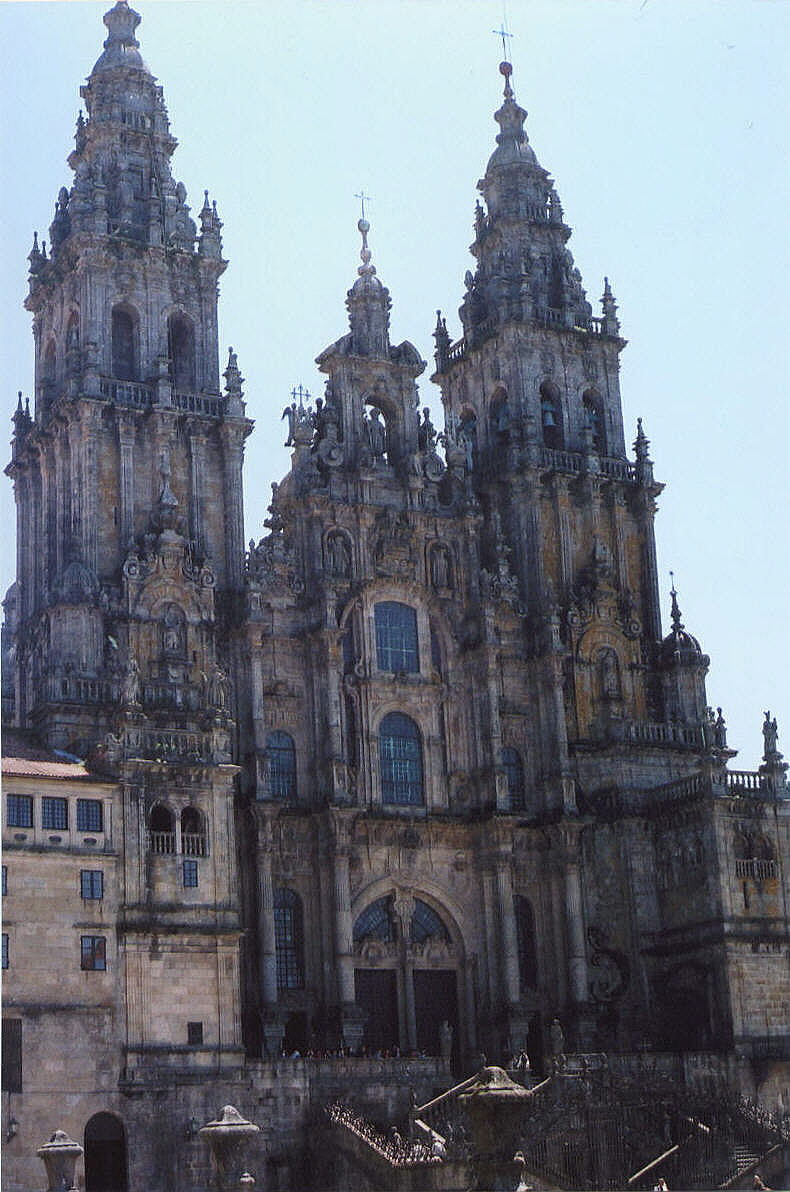
Santiago de Compostela
Cordoba reached the height of its material splendor under the Omayyad Caliphate of Abdu-r-Rahman III (d. 961) and the ruthless dictator Al-Mansur (d. 1002) who, after he razed the great church of Santiago de Compostela, forced Christian captives to carry the huge church bells back to his capital city. Thereafter, the opulent city suffered something of a decline in wealth and culture because of the repeated conquests of the fundamentalist Berbers from North Africa (the Almoravides and Almohades). Nevertheless, Cordoba remained a formidable target for any Christian attack. One night during the cold, rainy season at the end of 1235, a group of adventurous knights scaled the walls and gained possession of one of the suburbs and sent word to Fernando explaining their precarious circumstances.
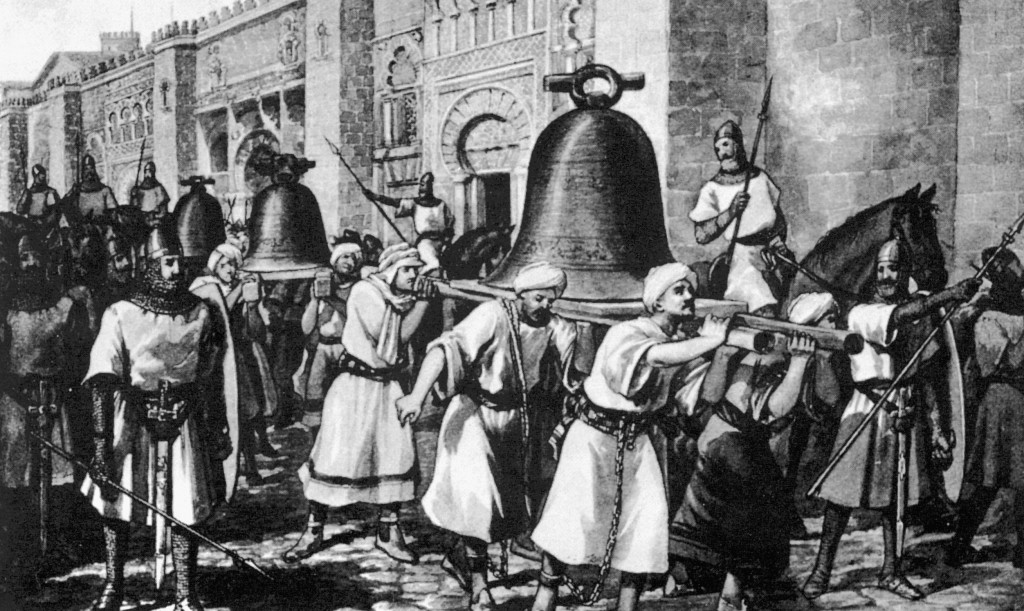
Knowing that his vassals had exposed themselves to great danger for their Christian faith, the warrior-King immediately gathered up a few companions and rode rapidly for the next few days through rain and floods to bring needed relief. As spring came on, Fernando, with increased forces, captured the main defending castle at the opposite end of town, ravaged the Moslem fields, and tightened the siege. Late in June, Cordoba, once the ornament of the world, capitulated. For the next few weeks, village after village came out and watched in amazement as Moslem captives carried the huge bells of Santiago on their shoulders back to Compostela.
Seville
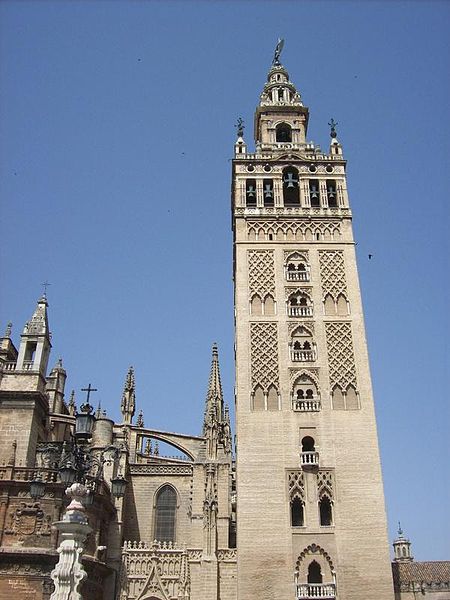
The Giralda in Seville, which is the bell tower for the Cathedral of Seville.
In 1246 Fernando besieged Jaen once again, having already failed three times. When it became evident that this time the fortified city would fall, the King of Granada, its master, knowing his own kingdom would be next, decided to cut his losses. He agreed to surrender Jaen and become Fernando’s vassal if the latter would allow him to keep the Kingdom of Granada, which included the port cities of Malaga and Almeria. Fernando approved and Granada became a vassal state of Castile, a status that it retained until 1492. The crusading Castilian could now turn his attention to Seville, the greatest city in Western Europe at the time. Seville was situated on the west or left bank of the Gaudalquivir River sixty miles from the Atlantic Ocean and was connected with its suburb, Triana, on the opposite bank by a bridge of boats.
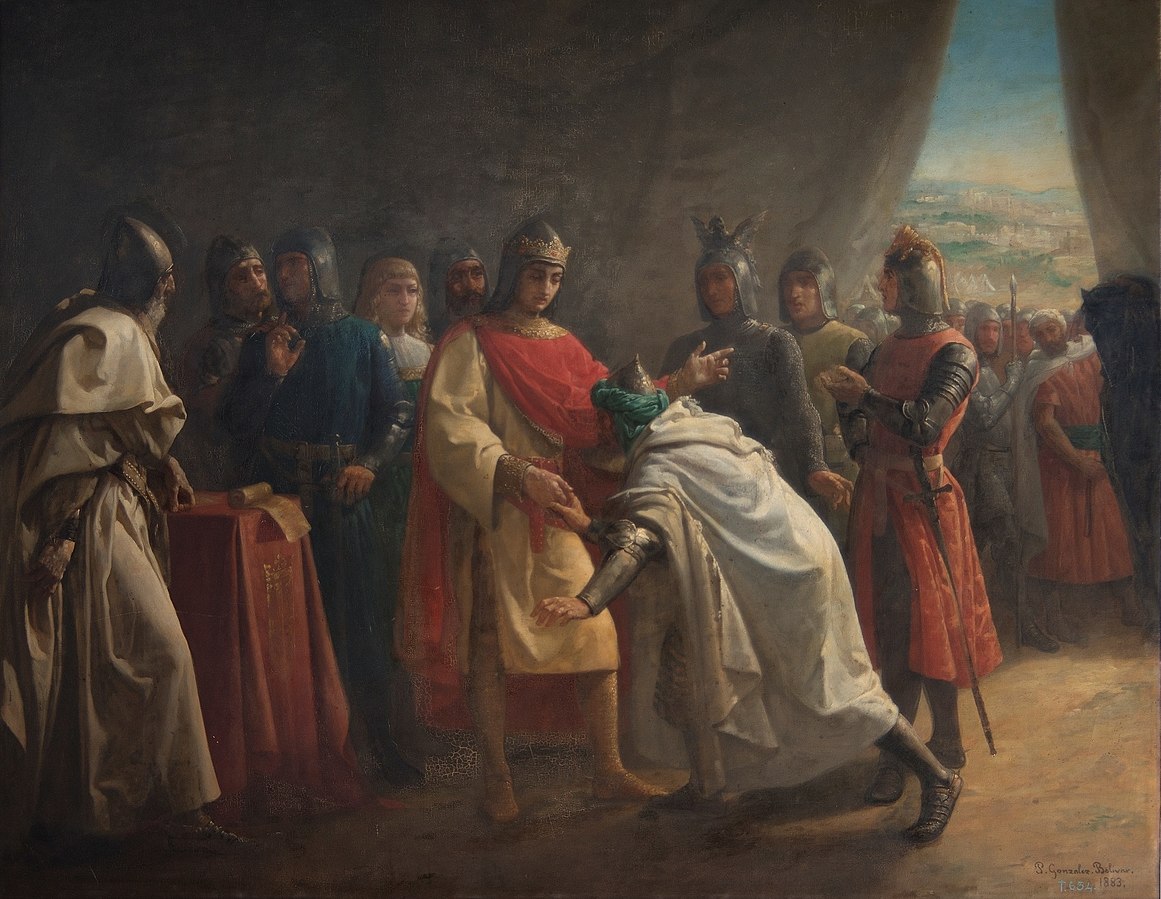
Painting depicting w:Muhammad I of Granada kissing the hand of King St. Ferdinand III of Castile, while surrendering Jaén and agreeing to be his vassal.
The river downstream, actually an estuary, was navigable. Fernando’s first task was to break the ring of walled towns and fortresses within a twenty mile radius that guarded the approaches to the city. The residents of those towns that capitulated could remain unmolested in their homes but had to turn over the citadels and fortifications to the Castilians. The towns that resisted were captured and the inhabitants killed.
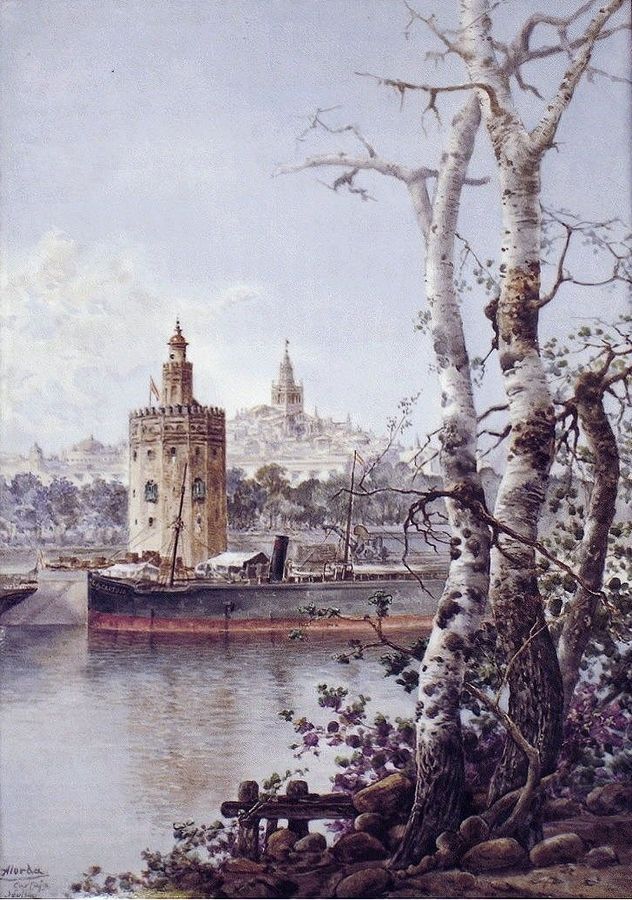
Guadalquivir river with Seville in the background. Painting by Ramon Alorda Pérez.
Since the Gualalquivir was navigable up to Seville, naval vessels played an integral part in the investment of the city in order to cut off communications and supply routes. The Spanish Admiral Ramon Boniface assembled a fleet in the Bay of Biscay, brought it around the peninsula, and after several engagements gained control of the river. His most spectacular success came in May 1248 when two large galleys rammed the bridge of boats with such force that the chains which held the boats in place snapped, allowing the current to carry the two halves harmlessly to shore. The siege reached a critical stage during the summer when famine, disease, and terrible heat brought unbearable suffering to both sides.
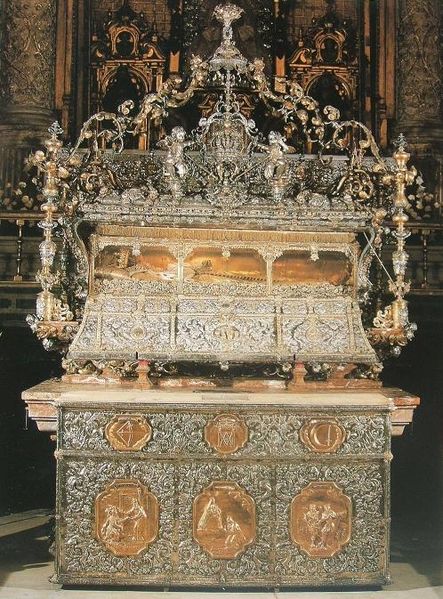
The incorrupt body of St. Ferdinand in the Royal Chapel at the Cathedral of Seville.
The moral elements of fortitude and determination gained in priority, which gave the advantage to the Christians because of their battle-hardened warriors, a large number of whom were the devoted monks of the military religious orders. The Moslems capitulated in November and after lengthy negotiations agreed to evacuate the city along with its dependent villages. Hundreds of thousands of Mohammedans under Christian escort retired to Granada or were transported to North Africa. The privations and austerities of camp life and the rigors of his spiritual life had destroyed San Fernando’s health, and he died shortly after in 1252. The great Crusader, whose body is whole and incorrupt to this day, was revered as a saint long before his canonization in 1671.
Stories on Honor, Chivalry, and the World of Nobility—no. 623
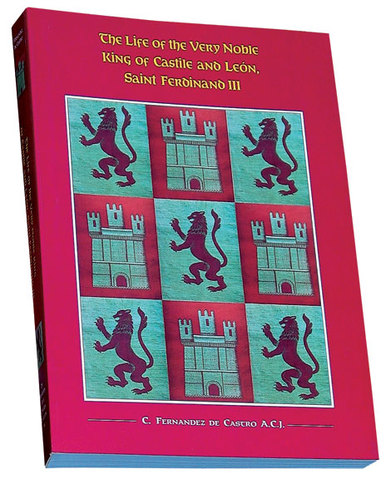
Bibliographical Note
The intimate details and quotations come from Sister Fernandez de Castro Cabeza, The Life of Saint Ferdinand III, Mount Kisco, N.Y., 1987. That biography, which was compiled from contemporary documents, especially the chronicles of Fernando’s son King Alfonso X, is available from the Foundation for a Christian Civilization.
Two other works that complement that information are Joseph F. O’Callaghan, A History of Medieval Spain (Ithaca, N.Y., 1975) and Derek Lomax, The Reconquest of Spain (London, 1978).
Comments